


This poster, originally designed in 1975 by Josef Müller Brockmann was designed for a Lamp Exhibit to be displayed at Kunstgewerbemuseum, a Museum of Decorative Arts in Germany. The poster is meant to advertise the exhibit to the public and grow interest, like most posters. Using striking simple shapes and tightly packed word clusters on a grid it is designed to be a unique and artistic interpretation of the Art Exhibit.
The poster’s focal point can be described as a large geometric circle made up of seven rows of lines of the same width, but the colour of the circle is chosen to create the illusion that it is illuminated. By putting the more saturated, lower value colours on the outside edges of the circle and the desaturated, high value ring of colour at the centre it strongly resembles the effect of looking at most man made light sources and creates a strong glow effect. Below the shape is the main type cluster which features the title of the event, the location, date & time the exhibit will be open and the names of each exhibit.
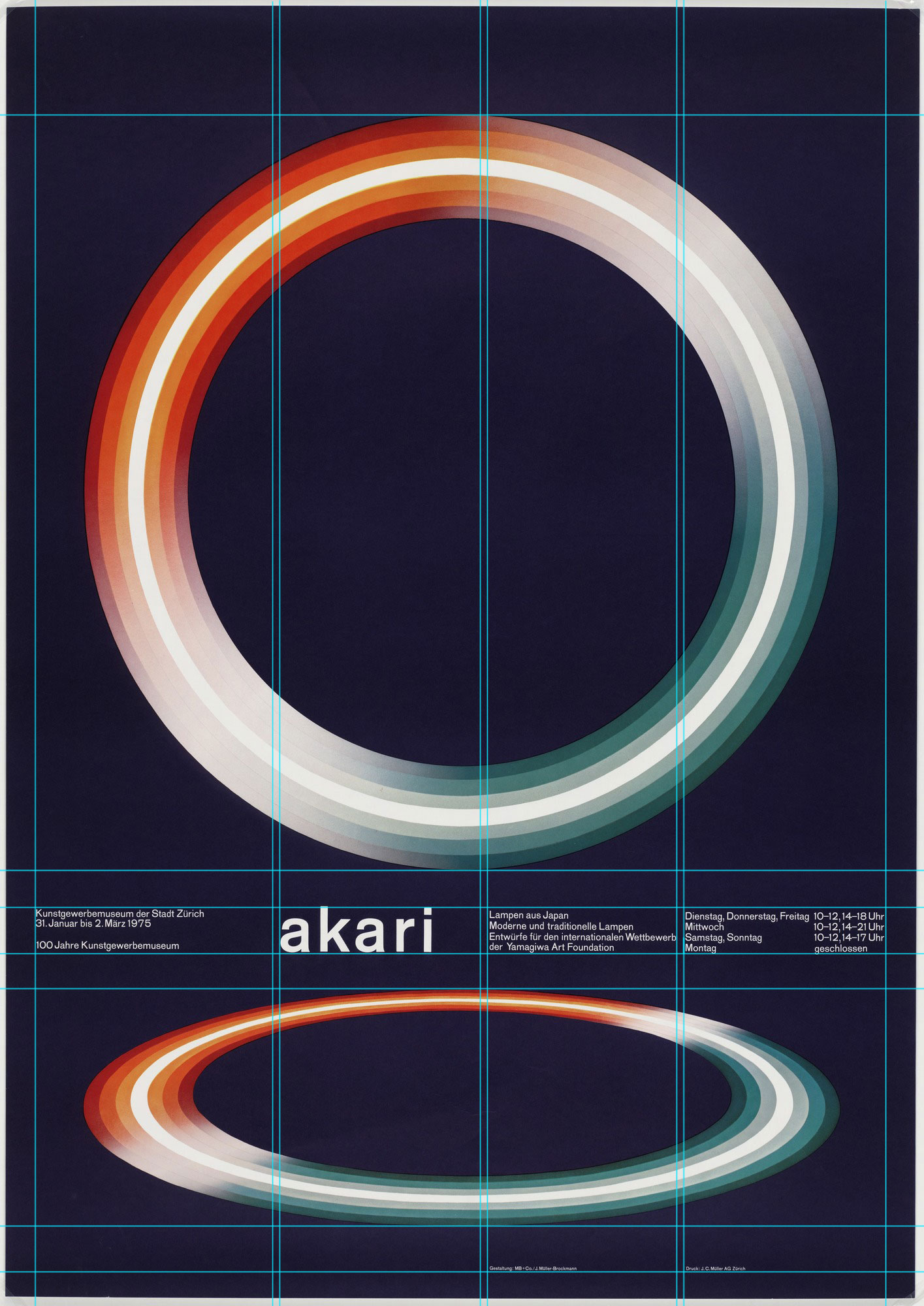
A few typographic & layout rules that this poster follows well that I can note are it’s use of composition, grids, colour & hierarchy. The poster is well balanced despite it’s asymmetrical layout, it uses the rule of thirds on the vertical axis of the poster to position the main line of text, as well the title is positioned by the rule of thirds horizontally so that it stand out, but also along the horizontal axis the text is split into a four column grid to create a uniform shape and space with the text. Spacing between each element in the grid is also equalized to create balance; between text and between shapes there is an equal amount of space as can be seen in this gridded dissection of the poster. The poster features a simple colour scheme using two complimentary colours with red and blue. Finally the text does feature a limited level of hierarchy by making the text of the title larger, letting it stand out.
A lot of the aesthetic choices of this poster were chosen despite breaking some general rules of typography, and for that reason I quite like it. When rules are broken to emphasize and strengthen a certain style that the designer intended to go for I feel it always makes for a unique and striking design. A few rules I can note being broken in this particular design are it’s sole dependance on reversed type, which understandably is more difficult to read than dark text on a light background, though I think it works very well on this poster. While not a sin in itself, Brockmann has a uniquely simplified approach to text hierarchy; there are only two levels of text despite the large amount of different information. I feel this simplified approach to hierarchy is very effective for such a simple layout as each text cluster fits the same height on four lines.
I think something that I definitely can take from this poster is that there can be a lot going on even for the most simple and minimalistic designs. Some of the most memorable posters and designs for me personally are those that are quite minimalistic but understanding why they were effective has made me appreciate their subtle use of design principles and how even the most simple looking design has a lot of underlying structure.


 Design Done brief